

PTO Versus Electric Hydraulic Systems
- Graham Thomas
- Jul 2
- 6 min read

When a truck body spec is close to final, the hydraulic power source often decides how well that unit performs in the field. PTO versus electric hydraulic systems is not a theoretical comparison for fleet buyers or body builders. It affects duty cycle, installation layout, maintenance planning, payload, and how reliably the equipment works under daily load.
For buyers sourcing dump bodies, service bodies, hooklifts, small trailers, or auxiliary hydraulic functions, the right answer depends less on preference and more on application. A system that is ideal for a light-duty intermittent function can become a weak point in a high-cycle operation. On the other hand, specifying a PTO-driven setup where an electric pack would do the job can add unnecessary complexity and cost.
PTO versus electric hydraulic systems in real applications
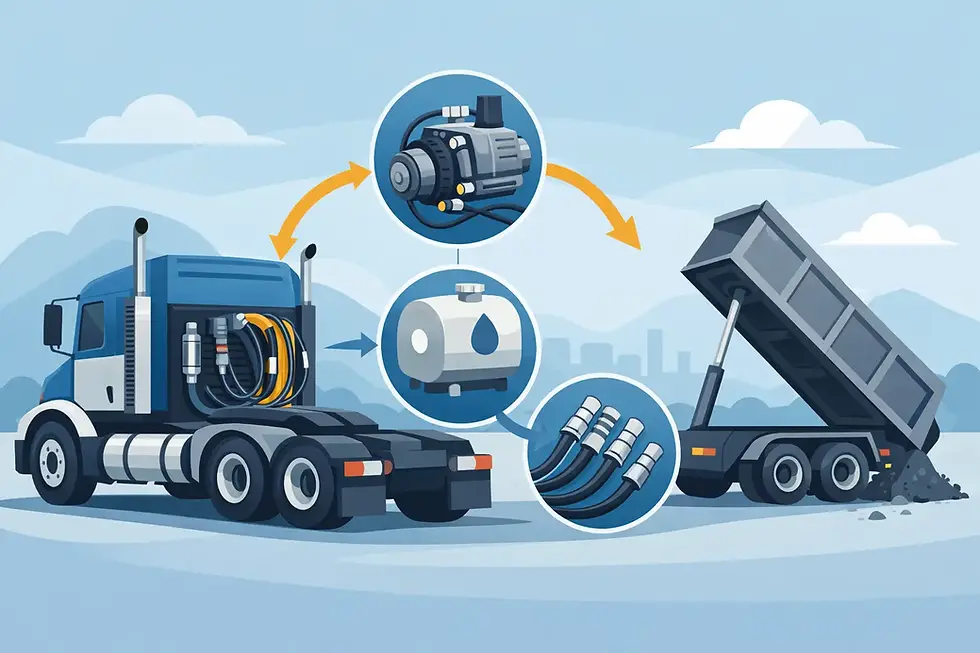
A PTO-driven hydraulic system takes mechanical power from the vehicle drivetrain, usually through the transmission, and converts it into hydraulic power through a mounted pump. This arrangement is common on dump trucks, wet kits, moving floors, walking floors, heavy tippers, and other equipment where sustained hydraulic output is required.
An electric hydraulic system uses a DC motor, normally powered by the truck battery and charging system, to drive a hydraulic pump. These units are often compact, self-contained, and practical for lighter or intermittent functions such as liftgates, small tipper bodies, service cranes, compact hook units, tail lifts, and auxiliary actuators.
The difference is not just how power is generated. It is how much hydraulic flow you need, for how long, how often, and under what operating conditions. That is where experienced buyers usually focus their evaluation.
Where PTO systems have the advantage
PTO systems are typically the stronger choice when the job requires continuous hydraulic power or higher flow rates. On a dump truck body that cycles repeatedly across a shift, a PTO-driven pump can deliver the flow and pressure needed without placing the same electrical strain on the vehicle.
This matters in construction, mining support, waste transfer, and bulk haul applications where equipment is expected to work hard, not just work occasionally. If the hydraulic function is central to the truck's revenue-producing role, PTO usually offers better long-run performance.
There is also an efficiency advantage in many heavy-duty setups. Because the system is driven mechanically, it can support larger pumps and more demanding circuits than a typical 12V or 24V electric power pack. That makes PTO a practical option for front-end hoists, underbody hoists, ejector bodies, live floor trailers, and other systems that need meaningful hydraulic capacity.
Another benefit is duty cycle. Electric hydraulic units are often limited by battery draw, motor heat, and recovery time. PTO systems are generally better suited to repeated operation over long periods, assuming the system is correctly matched to the transmission, engine speed, and pump requirements.
Where electric hydraulic systems make more sense
Electric hydraulic systems have clear advantages when the function is occasional, space is tight, or engine-driven PTO integration is not practical. They are often easier to package as a complete power unit with reservoir, motor, pump, valving, and controls in one assembly.
For lighter truck bodies and add-on functions, that can simplify both sourcing and installation. If the truck only needs to tip a small body a few times per day, or operate a compact accessory briefly, an electric unit may provide all the performance required without the added mechanical interfaces of a PTO system.
Electric systems can also work well on vehicles where PTO access is limited or unavailable. Some chassis configurations, emissions packaging layouts, and body designs create installation constraints that make a conventional PTO-driven system less attractive. In those cases, an electric power pack may allow a cleaner and faster integration.
Noise and operator convenience can also matter. For some applications, an electric unit offers straightforward push-button operation and a simpler user experience. Municipal, service, and utility fleets sometimes prefer that, especially on lower-demand equipment.
Cost is more than purchase price
On first review, buyers sometimes compare only the initial component price. That rarely gives a reliable answer.
A PTO system may involve a higher installation threshold because it can require PTO selection, pump mounting, shaft or direct-coupled arrangements, control integration, hose routing, reservoir sizing, and body-specific hydraulic design. The result may cost more upfront, particularly on custom builds.
An electric hydraulic pack may look less expensive at the start, especially for straightforward installations. But if the application pushes beyond intermittent use, the operating cost can rise through battery wear, charging system upgrades, slower cycle times, and reduced service life of electrical components.
The better commercial question is this: what is the cost of under-specifying the power source? If a truck cannot complete its normal cycle count, or if operators have to wait for recovery between functions, the savings disappear quickly.
Installation and chassis compatibility
Installation details often decide the outcome before the hydraulic circuit does.
A PTO-driven arrangement depends on transmission compatibility, PTO aperture availability, rotation requirements, torque limits, pump selection, and available space around the gearbox. On modern vehicles, packaging is not always generous. That means the hydraulic design needs to be coordinated with the chassis early, not treated as an afterthought.
Electric systems reduce some of that mechanical complexity, but they introduce their own considerations. Battery capacity, alternator output, cable sizing, voltage drop, fuse protection, relay performance, and control logic all need to be correct. A compact electric unit is only simple if the vehicle electrical system can support it properly.
For international buyers sourcing bodies and hydraulic components across multiple truck brands, this is where specification discipline matters. A system that works on one chassis family may need meaningful changes on another.
Maintenance, service, and uptime
From a maintenance perspective, neither option is automatically easier in every fleet. PTO systems involve mechanical driveline-related components and often more distributed hydraulic hardware. Electric systems reduce some of the mechanical integration, but add dependence on motors, solenoids, battery condition, and electrical health.
In harsh environments, electrical faults can be difficult to diagnose if water ingress, corroded terminals, weak grounding, or inconsistent charging are involved. In heavy-duty transport applications, those issues are not rare.
PTO systems, when properly specified, are often preferred for demanding fleets because the operating limits are better aligned with the application. They tend to make sense where uptime under load matters more than installation simplicity.
That said, for lighter-duty fleets with good maintenance controls and lower hydraulic demand, electric systems can be very serviceable and cost-effective. The point is not that one technology is superior in all cases. It is that maintenance outcomes usually reflect whether the original specification matched the work.
How to choose between PTO and electric hydraulic power
For most B2B buyers, the choice becomes clearer once four factors are defined: required flow and pressure, expected cycle frequency, available chassis interfaces, and acceptable installation cost.
If the body or equipment must perform repeated heavy lifts, sustained tipping, or continuous auxiliary hydraulic work, PTO is usually the safer choice. If the function is brief, infrequent, and moderate in demand, electric hydraulic power can be a practical and efficient option.
It also helps to think about future use, not only current use. Fleets often repurpose trucks or push equipment harder than originally planned. A narrowly sized electric system may become a limitation faster than expected. A correctly engineered PTO setup can provide more margin, although not every operation needs that margin.
For body builders and distributors, there is also a supply-chain consideration. A one-stop sourcing partner that understands truck bodies, cylinders, pumps, PTOs, valves, hoses, and fabrication can reduce mismatch risk across the whole assembly. That is often more valuable than finding the lowest individual component price.
Ningbo Han Valley International Trade Co. works with buyers who need that broader coordination because hydraulic performance is only one part of a complete vehicle solution.
The better question is fit, not preference
PTO versus electric hydraulic systems should be evaluated as an application decision, not a brand preference or standard habit. PTO systems generally win in high-demand, high-cycle, heavy-duty work. Electric hydraulic systems often make more sense for lighter, intermittent, or packaging-constrained applications.
A buyer who defines the duty cycle honestly, checks chassis compatibility early, and looks at total operating cost will usually reach the right answer. The hydraulic power source should support the body and the work without compromise. That is what keeps equipment productive once it leaves the yard.
Comments