

How to Choose Tipper Body for Your Fleet
- Graham Thomas
- 1 day ago
- 6 min read

A tipper body that looks suitable on a specification sheet can become an expensive operational problem if it is too heavy, poorly matched to the material, or incompatible with the truck and hydraulic system. Knowing how to choose tipper body equipment starts with the work it must complete every day, not simply its cubic capacity or purchase price.
For fleet operators, body builders, mining contractors, waste companies, and distributors, the right selection affects legal payload, unloading speed, maintenance demand, tire wear, fuel use, and vehicle uptime. The objective is not to buy the heaviest body available. It is to specify a body, hoist, and supporting components that deliver dependable service in the actual operating environment.
Start With the Material and Duty Cycle
The material being carried should drive the body specification. Sand, aggregate, demolition waste, scrap, grain, asphalt, ore, and municipal waste all behave differently during loading, transport, and discharge. Their density, abrasiveness, moisture content, particle size, and tendency to stick determine the required body volume, steel grade, floor thickness, and tailgate arrangement.
A body designed for low-density waste may offer high sideboards and large volume, but that same configuration is generally unsuitable for dense aggregate. The truck can reach its legal gross vehicle weight well before the body is full. In this case, excessive volume adds unnecessary tare weight and can make loading less efficient.
For abrasive products such as crushed rock, iron ore, or demolition material, floor and sidewall wear are major considerations. Thicker high-strength steel can extend service life, but it also reduces available payload. Wear liners may be a better choice where only certain areas experience severe abrasion, especially around the front bulkhead, floor, and tailgate.
Duty cycle matters just as much as material. A truck completing repeated short-haul quarry runs needs a different body from one hauling construction material over public roads or carrying waste on mixed urban routes. Consider loading frequency, average trip distance, expected annual tonnage, and whether the truck operates on paved roads, job sites, mines, or uneven landfill ground.
How to Choose Tipper Body Capacity Correctly
Body capacity should be calculated from both material density and legal payload limits. Do not select capacity based only on the volume of the material to be moved. A large body can create overload risk when hauling dense products, while a body that is too small may reduce productivity when hauling lighter bulk materials.
Start with the truck's allowable gross vehicle weight rating and subtract the chassis tare weight, body weight, hydraulic equipment weight, fuel, driver, and any installed accessories. The remaining figure is the practical payload allowance. That payload must then be compared with the density of the intended load.
For example, a body sized for mulch or general waste can be considerably larger than one fitted to the same chassis for wet sand. If the operation handles several materials, specify the body around the densest regular load, then assess whether removable side extensions or a different body profile can provide flexibility for lighter material.
The center of gravity also deserves attention. High body sides may increase volume, but they can affect stability when the truck is loaded, cornering, or tipping on uneven ground. This is particularly relevant for off-road work, waste transfer, and operations where loads can bridge or shift during discharge.
Select the Right Body Material and Construction
The main body material is normally a balance between abrasion resistance, weight, fabrication requirements, and cost. High-strength steel is widely used because it can provide good durability with reduced plate thickness. Standard structural steel may suit lighter-duty applications or operations where repair simplicity is more important than maximum wear life. Aluminum can reduce tare weight for selected applications, but it is not the best answer for every abrasive or impact-heavy load.
Construction details often matter more than headline material grades. Review the floor-to-sidewall design, top rail strength, front bulkhead profile, crossmember spacing, and reinforcement around hinge points. A tipper body needs sufficient stiffness to tolerate repeated loading and torsional chassis movement without developing cracks at stressed joints.
The floor should match the loading method. Excavator loading with large rock requires greater impact resistance than loading screened aggregate with a conveyor. If a body will regularly receive material from a loader bucket, identify expected drop height and maximum rock size early in the design process. These details affect floor thickness, body shape, and the need for local reinforcement.
Body shape also influences discharge. A smooth interior and suitable wall angle help materials release cleanly. Sticky clay, wet spoil, and compacted waste can remain in the front section or corners if the body geometry is unsuitable. In some applications, liners or anti-stick treatments can reduce carryback, although they should be assessed against temperature, abrasion, and repair requirements.
Match the Tipper Body to the Chassis
A body cannot be specified independently from the truck. The chassis wheelbase, axle configuration, frame section, rear overhang, suspension, and allowable body mounting points all affect what can be safely installed. Poor weight distribution can overload an axle even when total gross weight remains within limits.
The body length and position should place the loaded center of gravity where the chassis manufacturer and local regulations require it. This requires attention to the material's load profile, not just an empty body drawing. A load concentrated toward the front can create different axle loading from a free-flowing material that settles evenly.
The subframe is another critical part of the system. It transfers body loads into the truck chassis and must be designed to suit the intended service. A lightweight on-road tipper may use a different subframe arrangement from a severe-duty quarry body. The mounting method should permit appropriate chassis flex while preventing body movement, distortion, or mounting fatigue.
Check practical interfaces before production begins. Confirm clearance for cab tilt, fuel tanks, batteries, exhaust systems, fenders, spare tire carriers, and rear-mounted equipment. Small omissions at the drawing stage can cause significant installation delays later.
Specify the Hoist and Hydraulic System as One Package
The lifting system should suit the body length, payload, discharge angle, and operating conditions. Common arrangements include front-mounted telescopic cylinders and underbody hoists. Each has a place, and selection depends on body design, available space, stability requirements, and desired maintenance access.
A front-mounted telescopic cylinder is often used for higher-capacity tipping applications because it provides a direct lifting arrangement and can achieve useful tipping angles. Underbody hoists can be suitable for certain body types and may offer a compact installation, but they require careful evaluation of geometry, lifting capacity, and frame loading.
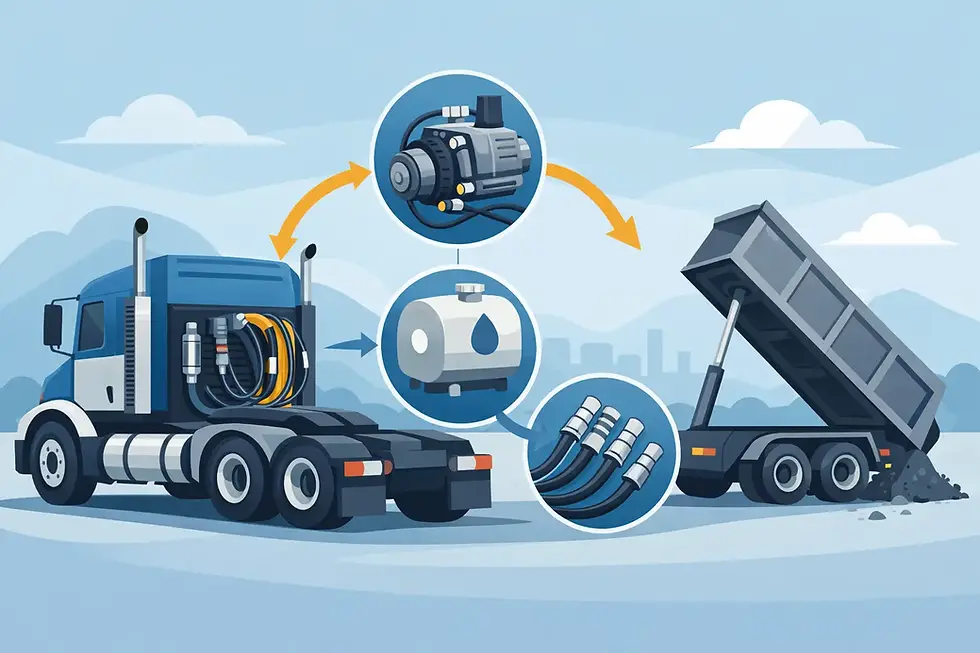
Hydraulic components must be correctly matched. The PTO, pump displacement, reservoir capacity, control valve, hoses, fittings, and cylinder should be sized as a working system. A body may tip slowly if pump output is inadequate, while excessive flow can create harsh operation or unnecessary heat. Pressure settings must match cylinder requirements and the vehicle's hydraulic design.
Specify safety equipment as part of the package, not as an afterthought. This can include body props, mechanical locks where required, pressure protection, hose routing and guarding, in-cab controls, and warning systems. For fleets operating on uneven ground, stability procedures and operator training remain essential even when the body and hoist are correctly specified.
Consider Tailgate, Covering, and Operating Details
Tailgate selection depends on how the material is discharged. A top-hinged tailgate is common for general bulk hauling, while barn-door, side-opening, or combination tailgate configurations may better suit waste, scrap, or materials that need controlled release. The latching system should be durable, accessible, and designed to release safely under load.
Additional features should reflect the application rather than be included by default. Sideboards, grain doors, tarp systems, ladder access, toolboxes, mudguards, work lights, reverse cameras, and load covers can all improve usability. They also add weight, cost, and maintenance points. Specify them where they solve a clear operational requirement.
For road operations, consider legal dimensions, rear underrun protection, lighting positions, conspicuity markings, and load containment requirements. For mine and site work, focus more closely on impact resistance, access safety, corrosion exposure, and compatibility with site operating rules.
Evaluate the Supplier Beyond the Body Price
The lowest quotation may not represent the lowest ownership cost. Compare suppliers on drawing capability, manufacturing controls, material traceability where required, welding quality, hydraulic component selection, inspection process, packing, documentation, and spare parts support.
For OEM and fleet procurement, clear technical communication is especially valuable. A supplier should be able to work from chassis data, payload targets, application details, and client drawings to produce a body specification that is buildable and repeatable. Ningbo Han Valley International Trade Co. supports this type of coordinated sourcing by combining tipper body fabrication with the hydraulic, pneumatic, and supporting vehicle components needed for a complete installation.
Before approving production, review the general arrangement drawing, material specifications, body weight estimate, hydraulic schematic, mounting design, and inspection requirements. Agree on tolerances and finish expectations in writing. A detailed approval process reduces the risk of a body arriving with avoidable fitment or performance issues.
The best tipper body is the one that carries the intended load legally, discharges safely, fits the chassis correctly, and remains economical to maintain through its working life. Build the specification around those operating facts, and the body will support productivity long after the initial purchase decision is forgotten.


Comments