
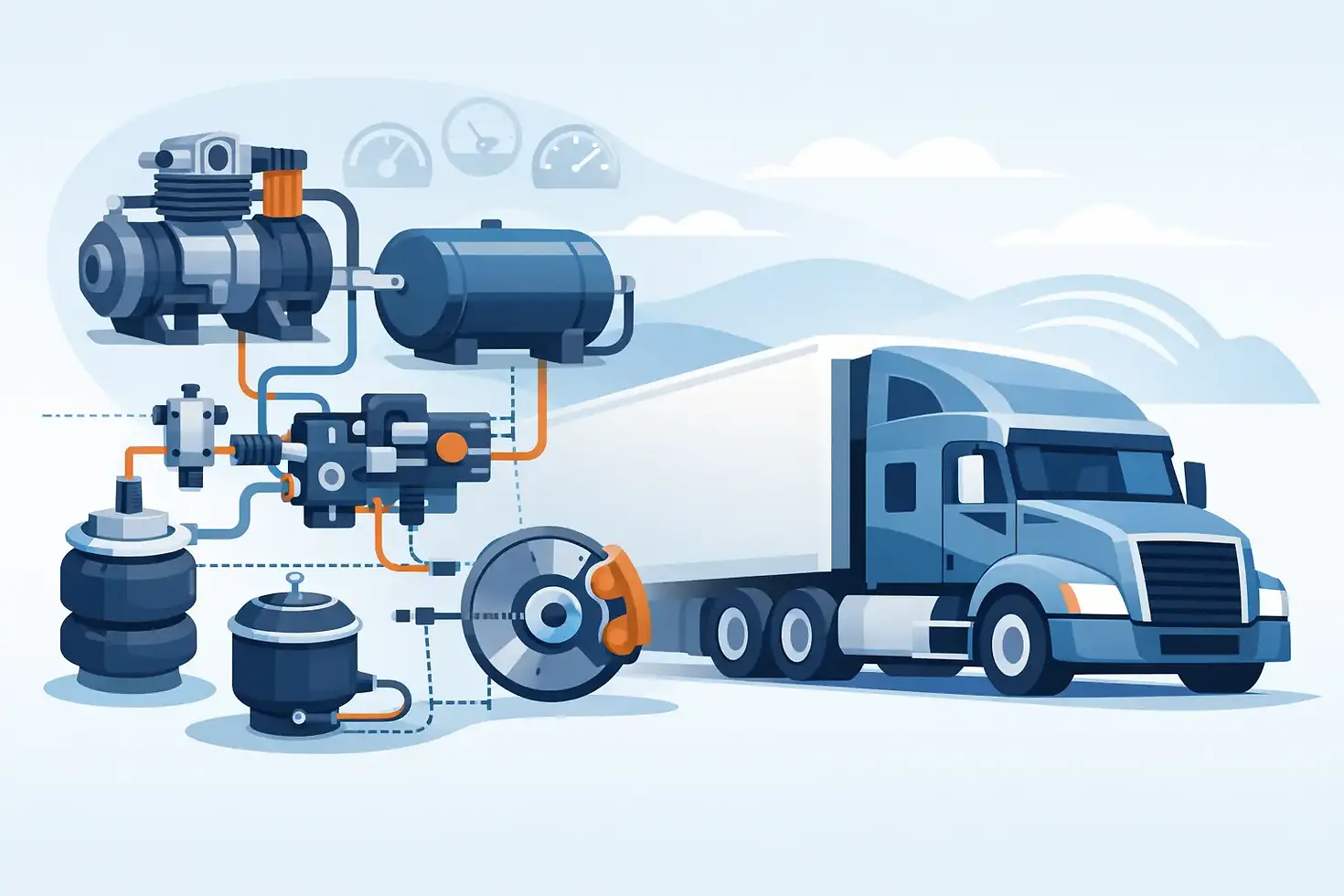
Pneumatic Control Systems for Trucks

A truck body or trailer can look right on paper and still underperform in service if the air controls are poorly specified. Pneumatic control systems for trucks sit behind many everyday functions that operators depend on, from brake actuation and suspension control to PTO engagement, tailgate release, differential lock operation, and auxiliary body equipment. When those controls are matched properly to the application, uptime improves. When they are not, small faults turn into safety risks, slow cycle times, and service headaches.
For B2B buyers, the issue is rarely whether a truck needs pneumatic control. The real question is how the system should be configured for the body, duty cycle, environment, and maintenance conditions it will face. That is where specification discipline matters.
What pneumatic control systems for trucks do
In heavy vehicle applications, a pneumatic control system uses compressed air to transmit force or operate a control function. On a working truck, that can mean a simple in-cab valve sending air to engage a PTO, or a more integrated arrangement controlling suspension, axle functions, tailgate locks, or other body-mounted equipment.
Air systems are well suited to truck use because compressed air is already available on many commercial vehicles. That makes pneumatics a practical choice for control tasks where reliability, fast response, and straightforward integration matter. In many body-building and trailer applications, pneumatic controls are preferred because they can be compact, repeatable, and easier to adapt across different vehicle layouts than purely mechanical linkages.
That said, not every function should be air controlled by default. The right setup depends on whether the task requires precise modulation, simple on-off operation, fail-safe positioning, or integration with hydraulic circuits and electrical interlocks.
Where truck pneumatic systems are commonly used
The most familiar truck air system is the braking system, but body and auxiliary applications are where buyers often need to pay closer attention. Pneumatic controls are commonly used for PTO activation, cab controls for hydraulic tipping systems, air tailgate release, locker control, axle lift systems, trailer functions, suspension adjustment, and safety interlocks tied to body equipment.
On dump trucks and tipper bodies, air controls often work alongside hydraulics rather than replacing them. The hydraulic system provides the lifting force, while the pneumatic side manages the command signal, engages associated functions, or operates locks and release mechanisms. On waste equipment, mining support vehicles, and specialty trucks, air controls may also be used where the operating environment is dirty, wet, or physically harsh enough to make mechanical cable systems less desirable.
This is one reason buyers should look at the full truck system rather than only the individual valve or actuator. An air control package that works well on one chassis or body type may not transfer cleanly to another without changes in pressure regulation, plumbing layout, valve mounting, or operator interface.
Core components that affect performance
Most truck pneumatic systems are built around a practical set of components: air supply, valves, actuators, fittings, hose or tubing, pressure protection devices, and control hardware inside the cab or on the body. The quality of each part matters, but the bigger issue is how they function together under real operating conditions.
Valves are usually where specification decisions become most visible. The valve type determines whether the function is momentary or maintained, manual or pilot operated, normally open or normally closed. A mismatch here can create operator confusion or unsafe movement. For example, a body function that should return to a safe state automatically may need spring return behavior rather than a latched valve.
Actuators also need careful attention. Stroke length, force requirements, mounting position, and environmental exposure all affect service life. If an air cylinder is undersized, contamination-prone, or mounted where road debris can damage the rod, the problem will show up in the field quickly.
Even fittings and tubing deserve more attention than they usually get. Routing that looks acceptable in a workshop can fail early if hose runs are exposed to abrasion, heat, impact, or repeated flex. In truck applications, vibration tolerance is not optional.
How to specify pneumatic control systems for trucks
The starting point is the function itself. Buyers should define what the air system is expected to do, when it should operate, and what conditions must prevent operation. A PTO engagement control on a tipper truck is not just a valve selection exercise. It may also require interlocks related to transmission position, parking brake status, hydraulic circuit logic, and body safety procedures.
After function comes air availability. Not every chassis provides the same reserve capacity, pressure stability, or connection layout for auxiliary equipment. If multiple body functions rely on air, the system must be assessed as a total demand package. Low air reserve can lead to delayed actuation or inconsistent behavior, especially in stop-start fleet work.
The duty environment is next. Trucks in mining, waste, municipal, and heavy haul service place different demands on control systems than standard on-road applications. Dust, washdown exposure, corrosion, freezing conditions, and impact risk all influence component choice. A lower-cost valve may be acceptable in light-duty service but become an expensive decision in severe-duty use.
Control ergonomics should not be overlooked. Operators need clear, repeatable control inputs that reduce mistakes. Poorly labeled valves, awkward mounting, or inconsistent actuation sequences can slow work and increase wear. In industrial truck applications, simplicity usually wins.
Trade-offs buyers should consider
Pneumatic systems offer real advantages, but there are trade-offs. Air controls are generally durable and practical, especially where trucks already have onboard compressed air, but they are still vulnerable to contamination, leaks, and pressure-related performance issues. A system with too many connection points or unnecessary complexity becomes harder to maintain.
There is also a cost balance between standardization and customization. A standard control package can shorten lead times and reduce procurement complexity. However, if the truck body, chassis layout, or duty cycle is specialized, a standard package may create downstream service costs that outweigh the initial savings.
Another common trade-off is between simple manual control and more advanced integrated systems. Basic air valve arrangements are easier to troubleshoot in the field. More complex systems can improve safety and functionality, but only if they are documented properly and supported with the right installation and service knowledge.
Common failure points in service
Most pneumatic system problems do not begin with catastrophic component failure. They start with small leaks, contamination, poor routing, loose fittings, moisture management issues, or incorrect installation. Over time, these reduce response speed and reliability.
In truck body applications, one common issue is treating the air control package as an accessory rather than a system. A quality valve installed with poor hose routing or inadequate protection will not perform well for long. Another issue is failing to account for serviceability. If technicians cannot access valves, test lines, or fittings easily, routine maintenance gets delayed.
Moisture and contamination are also recurring problems. If the upstream air quality is poor, valve internals and actuators can suffer. In cold climates, moisture can create seasonal reliability issues that look like random component faults until the root cause is addressed.
Why integration matters with hydraulics and body equipment
Many truck applications depend on both pneumatic and hydraulic systems working together. On a tipper, hooklift, tanker, or specialty service body, the air controls may be the operator-facing command layer for hydraulic movement. If the two systems are not coordinated, the result is slow response, improper sequencing, or unsafe operation.
For that reason, sourcing air controls in isolation is not always the best buying approach. Buyers often get better results when the pneumatic package is specified with the body equipment, hydraulic components, mounting provisions, and fabrication details in mind. That is especially true when the equipment must fit customer drawings, regional compliance expectations, or mixed fleet requirements.
This is where an experienced OEM supply partner adds value. Companies such as Ningbo Han Valley International Trade Co. work with buyers who need more than individual parts. They need truck bodies, hydraulic assemblies, pneumatic components, and fabrication support aligned from the start so installation is cleaner and field performance is more predictable.
What procurement teams should ask suppliers
A serious supplier should be able to discuss operating pressure, valve logic, material suitability, hose routing considerations, actuator sizing, mounting details, and compatibility with the intended truck or trailer platform. If those conversations stay at the catalog level, the risk of mismatch goes up.
Buyers should also ask how the system will be documented, tested, and packed for delivery. OEM-grade supply is not only about the component brand or unit cost. It is also about consistency across repeat orders, control over specification changes, and confidence that the delivered system matches the approved build.
For fleets and distributors, long-term parts continuity matters as much as first-fit performance. A control package that cannot be supported across future orders creates avoidable procurement friction later.
Pneumatic control systems for trucks are not the most visible part of a build, but they have an outsized effect on usability, safety, and uptime. When the specification is right, operators barely think about them, and that is the point. The best result is a system that does its job every day, fits the truck properly, and keeps the equipment moving without drama.


Comments