

Hydraulic Valves vs Pneumatic Valves for Trucks
- Graham Thomas
- Jul 12
- 6 min read

A tipper body that will not hold position, a trailer brake circuit that responds slowly, or a compactor cycle that loses power can all trace back to the wrong valve choice. The hydraulic valves vs pneumatic valves decision is not simply a matter of available components. It determines the force available at the actuator, the control architecture, maintenance exposure, safety requirements, and total operating cost of the vehicle or equipment.
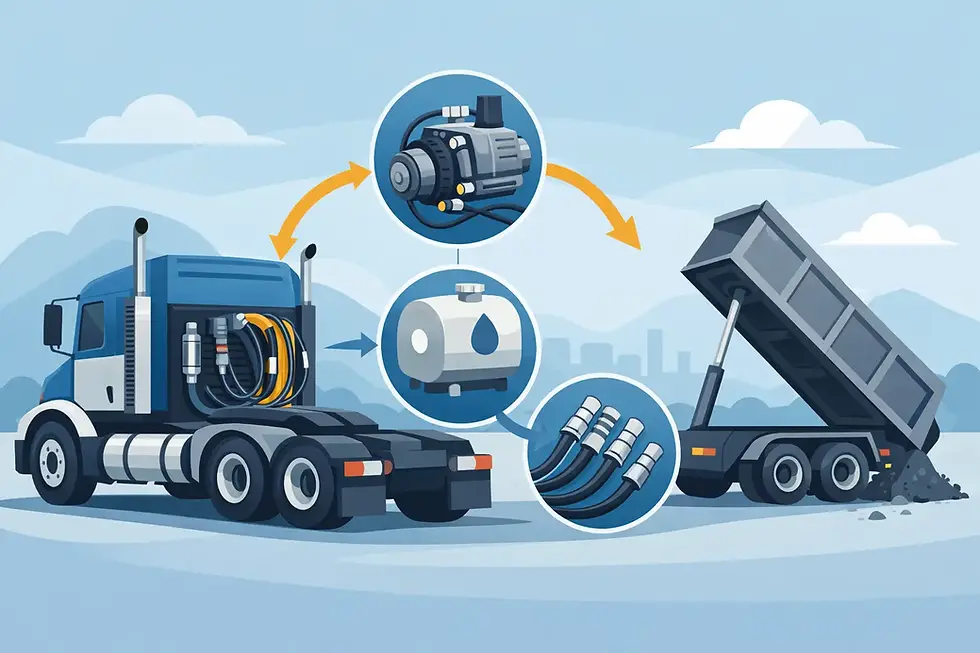
For heavy transport, mining, and waste applications, hydraulic and pneumatic systems often operate on the same machine. A dump truck may use hydraulics to raise the body and air-operated controls for braking or auxiliary functions. The practical question for a buyer is not which technology is universally better. It is which valve system is right for the duty cycle, load, environment, available power source, and required level of control.
Hydraulic Valves vs Pneumatic Valves: The Core Difference
Hydraulic valves direct, regulate, or stop the flow of pressurized oil. Because hydraulic fluid is effectively incompressible, a hydraulic system can transmit substantial force with controlled movement. Directional control valves, relief valves, flow-control valves, counterbalance valves, sequence valves, and check valves each perform a defined job in managing that energy.
Pneumatic valves perform similar control functions using compressed air. Air is compressible, which makes pneumatic systems faster to cycle in many applications and naturally suited to on-off actuation. Common pneumatic valve types include directional control valves, pressure regulators, quick-exhaust valves, check valves, shuttle valves, and solenoid valves.
The difference becomes clear at the actuator. A hydraulic cylinder can lift a loaded dump body, operate a high-force ejector, or control a heavy trailer mechanism with compact hardware. A pneumatic cylinder is well suited to lighter clamping, latching, gate control, brake functions, and repeated high-speed movements where extremely precise load control is not required.
When Hydraulic Valves Are the Better Choice
Hydraulic valves are generally the correct choice where high force, controlled movement, and load holding are central to the job. This includes tipper bodies, hook lifts, skip loaders, hydraulic tailgates, mining attachments, crane functions, compactors, and heavy-duty trailer equipment.
High force in limited installation space
Hydraulic systems produce high working force without requiring oversized cylinders or extensive mechanical linkages. This is especially valuable on commercial vehicles, where chassis space, payload, and body geometry are tightly controlled. A properly sized directional valve and cylinder arrangement can move a large load reliably from a truck-mounted power take-off and pump.
For example, the main control valve on a dump truck must manage oil flow to raise and lower the hoist cylinder. It may also need float, power-down, pressure protection, or multiple spool functions for auxiliary equipment. These requirements favor hydraulic control because the system can apply and hold force throughout the working stroke.
Controlled speed and load holding
Oil flow can be metered to control cylinder speed with greater consistency than compressed air in heavy-load applications. Flow-control valves manage the rate of movement, while counterbalance and pilot-operated check valves prevent a load from running ahead of the pump or dropping unexpectedly.
This matters when a truck body is raised with a load, when a tailgate must remain in position, or when an actuator is exposed to changing resistance. In these situations, a basic directional valve alone is often not enough. The valve assembly must include protection against overpressure, uncontrolled descent, and pressure spikes caused by sudden changes in load.
Better fit for severe-duty equipment
Hydraulic circuits are common in mining, waste handling, and construction equipment because they can withstand repeated high-load cycles. However, performance depends on clean oil, correct filtration, suitable hose routing, and valves matched to actual pressure and flow. A valve selected only by port size can become a restriction, generate excess heat, or fail to provide the required control characteristics.
Hydraulic systems do have trade-offs. Leaks create housekeeping and environmental concerns, oil contamination can damage precision components, and maintenance personnel need to understand pressure hazards. Seal compatibility, fluid viscosity, operating temperature, and contamination control should be considered at the specification stage, not after equipment enters service.
When Pneumatic Valves Are the Better Choice
Pneumatic valves are often the more efficient option when the equipment already has a compressed-air supply and the required actuator force is moderate. Road transport applications are a clear example. Trucks and trailers rely on air systems for braking, and air can be readily available for selected auxiliary controls.
Fast, simple actuation
Pneumatic directional valves can provide quick response for functions such as locking pins, door actuators, tarp systems, chute controls, and mechanical interlocks. They are also useful where a simple extend-retract movement is sufficient and minor variation in speed or position is acceptable.
Air-powered systems can be simpler to route over a trailer or body than hydraulic return lines, particularly for low-force functions. Air leaks are generally cleaner than oil leaks, although they still reduce compressor efficiency and can cause unreliable operation if ignored. Moisture and contamination remain important concerns, especially in cold regions where water in the air system can freeze.
Natural fit for brake and control circuits
Pneumatic control is integral to commercial vehicle braking because compressed air offers a practical fail-safe approach. Loss of air pressure can apply spring brakes rather than leaving the vehicle without braking force. Specialized valves control charging, relay response, emergency functions, parking brakes, and trailer supply circuits.
These applications should not be treated as generic air-valve selection. Brake-system valves require correct approval, configuration, pressure rating, port arrangement, and compatibility with the vehicle's brake architecture. For fleet and trailer buyers, specification accuracy is a safety and compliance issue as much as a purchasing issue.
Limits under heavy or variable loads
Compressed air stores energy differently from hydraulic oil. Its compressibility can lead to less rigid motion, pressure losses over long lines, and variable actuator behavior as loads change. A pneumatic cylinder may be suitable for a latch, but it is not normally the right primary actuator for lifting a loaded steel body or controlling a high-force compaction cycle.
Pneumatics also demand a dependable air source. Compressor capacity, reservoir volume, dryer performance, line condition, and other air consumers affect available pressure. If auxiliary equipment can compromise brake-air reserves or create unpredictable demand, the circuit must be designed with protection and priority control.
Valve Selection Should Start With the Circuit
The valve itself should be selected after the operating requirement is defined. Buyers should establish the available pressure and flow, required actuator force, duty cycle, fluid or air quality, ambient temperature range, installation space, electrical control requirements, and safety function. These factors determine not only valve type but also spool configuration, pressure rating, flow capacity, port thread, coil voltage, sealing materials, and mounting style.
For hydraulic applications, confirm maximum system pressure, normal working pressure, pump flow, return-line capacity, and whether the actuator must hold a suspended load. A directional valve that handles the pump flow may still need a relief valve, load-holding valve, or flow-control section to make the circuit safe and usable.
For pneumatic applications, confirm operating pressure, air consumption per cycle, valve flow coefficient, line length, expected temperature, and air treatment. A valve that works correctly on a clean test bench can become slow or unreliable in a working truck if water, oil carryover, road debris, or voltage drop reach the system.
Electrohydraulic and electro-pneumatic controls add another layer. Solenoid-operated valves support remote control, automation, and cab-mounted switches, but their coils must match the vehicle electrical system and environmental exposure. Manual override capability can be valuable for service access, but it should not create an unsafe bypass of a load-holding or brake-related function.
Cost, Maintenance, and Supply Considerations
Initial purchase price is only one part of the decision. Pneumatic valves and actuators can offer lower-cost, straightforward control for light-duty functions where onboard air is already available. Hydraulic systems usually carry higher component and installation costs, but they provide the force density needed to replace larger mechanical arrangements or impractical air actuators.
Maintenance planning should focus on the entire system. Hydraulic valve life depends heavily on filtration, oil condition, seals, hose cleanliness, and correct pressure settings. Pneumatic valve life depends on dry, clean air; sound fittings; protected wiring; and regular inspection for leaks and damaged lines. In both cases, common replacement parts and clear identification of valve specifications reduce downtime.
For OEM equipment programs, consistency matters as much as individual component quality. A valve supplier should be able to support the required configuration across production batches, coordinate compatible pumps, cylinders, hoses, fittings, and controls, and work to drawings where a standard catalog item does not fit. Ningbo Han Valley International Trade Co. supports this approach by coordinating hydraulic and pneumatic components alongside truck bodies, trailers, and fabricated equipment requirements.
Specify the Function, Then Select the Valve
The best choice follows the work being done. Use hydraulic valves when the application requires high force, stable load control, and dependable movement under heavy duty. Use pneumatic valves when fast, clean, moderate-force actuation suits an existing air system, particularly for brake-related or auxiliary vehicle functions.
Before releasing a purchase order, review the circuit with the actual operating conditions in mind: loaded versus unloaded movement, cold starts, contamination exposure, operator behavior, service access, and the consequences of a valve failure. That discipline produces equipment that is easier to operate, safer to maintain, and better prepared for the hours it is expected to work.


Comments