

Choosing Truck Bodies for Heavy-Duty Work
- Graham Thomas
- Jul 8
- 6 min read

A truck body that looks right on paper can still create problems in service. Floor wear may be too high for the material being hauled, tare weight may cut into payload, or hydraulic layout may not suit the duty cycle. For buyers responsible for uptime, the real question is not simply which truck bodies are available. It is which body design, material, and supporting system match the application with the fewest compromises.
What truck bodies need to do in real operations
In commercial fleets, mining support, construction haulage, and waste work, truck bodies are working assets rather than cosmetic add-ons. They need to carry the intended load safely, discharge efficiently, withstand repeated loading impact, and fit the chassis, axle ratings, and operating environment. A body that performs well in light aggregate service may be the wrong choice for demolition debris, scrap, or abrasive rock.
That is why specification matters early. Body length, side height, floor thickness, headboard design, tailgate arrangement, underbody structure, and mounting method all affect service life and operating efficiency. The right body is a combination of structural design and practical details. If either is off, maintenance costs rise quickly.
For B2B buyers, there is also a sourcing issue. Truck bodies rarely operate alone. They rely on hydraulic cylinders, PTOs, pumps, hoses, valves, and fittings, along with fabrication accuracy and installation compatibility. Treating the body and the supporting systems as one package usually reduces risk.
Common truck bodies and where each fits best
The broad category of truck bodies covers several body types with different operating purposes. Selecting the right one starts with the load profile and discharge method.
Tipper and dump bodies
Tipper bodies and dump truck bodies are used where fast unloading is required for bulk material. These bodies are common in construction, quarry support, road building, agriculture, and general material haulage. Their value is simple - quick cycle times and straightforward operation.
Even within this category, the correct design depends on the job. A lighter body may suit sand, grain, or general aggregate where payload is critical. A heavier body with wear-resistant floor and side materials is often better for hard rock, demolition waste, or high-impact loading. The trade-off is clear: lower tare weight improves payload, but more steel or wear plate usually improves durability.
Tray and platform bodies
Tray bodies are suited to applications that require open access from the sides and rear. They are common in service fleets, utility work, equipment transport, and general trade use. The key issue here is not only deck dimensions but how the tray integrates with tie-down points, underbody storage, toolboxes, and mounting accessories.
For many fleet buyers, a tray body becomes more valuable when it is built around the way crews actually work. That may mean ladder racks, side protection, reinforced flooring, crane preparation, or integrated storage. A generic tray can do the job, but a purpose-built one usually does it more efficiently.
Specialty bodies
Specialty bodies cover a wide range, from waste and municipal applications to service and industrial support vehicles. These bodies often require more coordination because body fabrication, tank arrangements, compartment layouts, or hydraulic and pneumatic systems may all be involved.
In these cases, the challenge is less about choosing a standard product and more about translating an operational requirement into a buildable specification. That is where experienced OEM coordination becomes valuable.
Material choice affects both payload and service life
Material selection is one of the most important decisions in truck bodies. Buyers usually weigh three factors: durability, weight, and cost.
Mild steel remains common because it is cost-effective, widely understood, and suitable for many general-duty applications. For buyers operating in moderate conditions, it often delivers acceptable service life at a lower initial cost. The limitation is wear resistance. In abrasive or impact-heavy work, mild steel may require more frequent repair or replacement.
Hardox-type wear plate or other high-strength, wear-resistant materials are often selected for heavier duty conditions. These materials can improve body life and, depending on design, may allow reduced section thickness without sacrificing performance. That said, higher-grade material alone does not guarantee a better result. Design quality, welding standards, and reinforcement layout still matter.
Aluminum can be attractive where payload optimization is a priority, especially in certain transport applications. The benefit is lower body weight. The downside is that aluminum is not the right answer for every abrasive or impact-prone environment. It depends on the material being carried, loading method, and expected duty cycle.
A good specification does not chase the lightest or heaviest option by default. It chooses the material that makes the most commercial sense over the life of the asset.
The body design details that buyers should not overlook
Some of the most expensive problems come from details that are missed during procurement. Floor thickness is one example. If it is underspecified, wear can become a recurring cost. If it is oversized for the job, tare weight and fuel efficiency may suffer unnecessarily.
Side wall design also matters. High sides may increase volume, but they can also affect stability depending on the load type and operating conditions. Headboards need to suit loading practice, particularly if loader impact is a concern. Tailgate design must match discharge needs. A simple top-hinged arrangement may be enough for one operation, while another may need a high-lift or air-operated setup.
Then there is the subframe and mounting arrangement. These need to work with the chassis and the duty. Poor integration can lead to cracking, uneven load transfer, or installation complications. Buyers who focus only on the visible body structure can miss the parts that carry much of the real stress.
Hydraulics and supporting systems are part of the decision
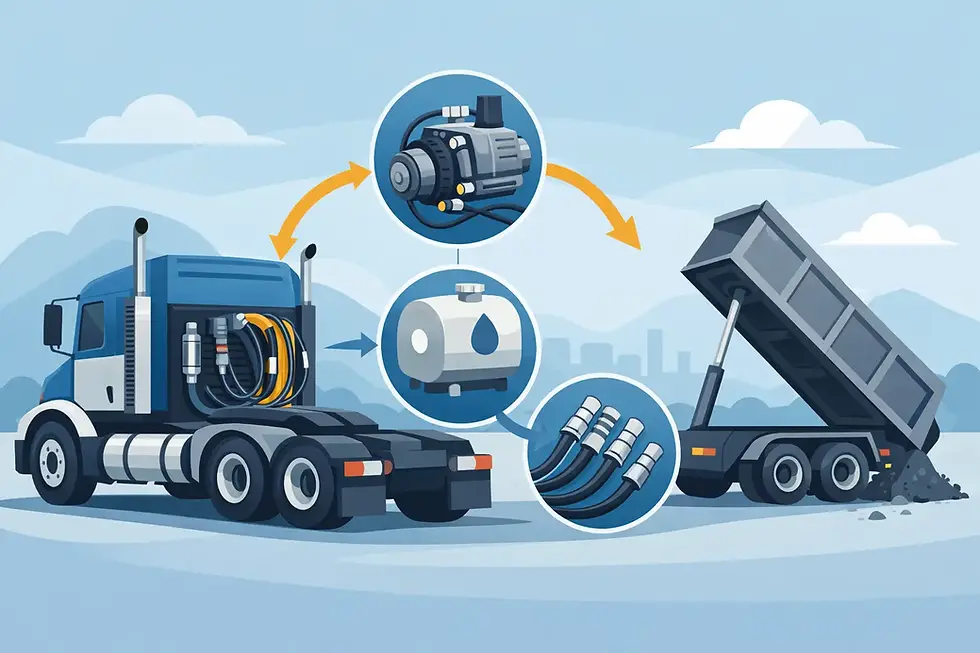
Truck bodies that rely on tipping or powered functions are only as dependable as the systems behind them. Hydraulic cylinders, PTOs, pumps, hoses, valves, and fittings need to be selected as part of the overall build, not added as an afterthought.
This matters for performance and serviceability. A body may be structurally well built, but if the hydraulic system is poorly matched, cycle times can be slow, heat can build up, and component life can be shortened. In fleet environments, even small mismatches become costly when multiplied across multiple vehicles.
For international buyers, coordinated supply also has practical value. Sourcing the body from one supplier and key hydraulic or pneumatic components from another can work, but it often adds interface risk. A one-stop supply approach can simplify specification control, compatibility, and purchasing administration. That is one reason many OEM and fleet buyers prefer suppliers that understand both fabrication and system integration. Companies such as Ningbo Han Valley International Trade Co. operate in that space because many customers want complete body solutions supported by the right components.
Customization is often the difference between adequate and efficient
Standard truck bodies have a place, especially when applications are consistent and lead time is critical. But many commercial buyers do not operate under standard conditions. Chassis dimensions vary, local regulations differ, and load types can be highly specific.
Customization does not always mean a fully bespoke build. It may simply mean adjusting dimensions, floor material, side configuration, toolbox integration, or hydraulic layout to suit the vehicle and task. Those changes can improve payload, speed up loading and unloading, reduce service issues, and make the unit easier to maintain.
The key is disciplined customization. Changes should solve an operating problem or improve commercial performance. They should not add unnecessary complexity. Experienced buyers usually know this well: every custom feature should justify itself in uptime, safety, or total operating cost.
What to ask a truck body supplier before ordering
A capable supplier should be able to discuss application details, not just quote a body shell. Buyers should expect a conversation about material type, load characteristics, duty cycle, chassis integration, hydraulic requirements, and fabrication standards. If the discussion stays too general, there is a higher chance that assumptions are being made.
It is also worth checking how the supplier handles drawings, revisions, and production control. For OEM and fleet procurement, specification accuracy is not a minor issue. It affects installation, parts compatibility, and long-term repeatability. A supplier with broad category coverage can also be useful when the project includes body hardware, hydraulics, pneumatics, tanks, trailers, or fabricated accessories.
Lead time and price will always matter, but they should be judged alongside reliability and fit-for-purpose engineering. A cheaper body that wears out early or creates installation problems is rarely the lower-cost option.
The strongest truck body procurement decisions are usually practical rather than dramatic. They come from understanding the load, the chassis, the work cycle, and the systems that support the body day after day. When those pieces are aligned, the equipment tends to perform the way it should - and that is what buyers remember long after the order is placed.


Comments