

Best Trailer Landing Gear for Heavy-Duty Fleets

A loaded semi-trailer can spend hours waiting at a dock, but its landing gear may be operated only a few minutes per trip. That short task carries real consequences. The best trailer landing gear keeps a detached trailer stable, allows drivers to couple and uncouple efficiently, and avoids the bent legs, stripped gears, and costly roadside repairs that take equipment out of service.
For fleet operators, body builders, and trailer distributors, the right choice is not simply the highest rated product on a catalog page. Landing gear must suit the trailer’s front-end loading, operating environment, frame design, support-foot conditions, and expected service cycle. A well-specified set provides predictable performance over years of use. An underspecified set can become a recurring maintenance problem.
What Defines the Best Trailer Landing Gear?
Landing gear is a mechanical support system fitted near the front of a semi-trailer. It normally consists of two telescoping legs, a gearbox, a connecting cross shaft, braces, crank handle, and feet or sand shoes. When the trailer is uncoupled, the legs transfer the trailer’s kingpin-end load to the ground. During coupling, they must retract fully and clear the operating surface.
The best trailer landing gear for a commercial application balances lifting capacity, structural strength, operating speed, and serviceability. The gear must withstand more than the nominal vertical load. It also sees side loading from uneven ground, shock loads during handling, torque from cranking, and corrosion from water, road salt, fertilizer, or waste operations.
A high capacity rating alone does not guarantee suitability. A heavy-duty lowboy working on compacted yard surfaces needs a different foot configuration and leg travel than a dry van trailer that spends most of its life on paved distribution centers. Likewise, a fleet that requires frequent drop-and-hook operation will value fast extension and a dependable two-speed gearbox more than a fleet that rarely uncouples trailers.
Start With Actual Front-End Load
The first specification is the maximum loaded weight carried at the trailer nose when it is unsupported by the tractor. This is not necessarily the trailer’s gross vehicle weight rating. Weight distribution, axle placement, body configuration, cargo movement, and loading practice all affect the kingpin-end load.
For standard highway semi-trailers, landing gear is often selected in rated capacities such as 50,000 lb, 55,000 lb, or higher. The appropriate rating should include a reasonable safety margin for real operating conditions, but capacity should be evaluated alongside the manufacturer’s stated testing basis. Procurement teams should confirm whether the figure refers to static support capacity, lifting capacity, or another defined performance condition.
Lifting a trailer that has settled under load requires greater effort than simply holding it at a fixed height. If the landing gear will regularly raise loaded trailers for coupling, select a system designed for that duty. If drivers are expected to lift only an unloaded or lightly loaded trailer, the operating requirement may be less demanding, though the structural support requirement remains critical.
Consider Uneven Ground and Dynamic Use
Landing gear is not designed to correct severe trailer imbalance or support a trailer on unstable soil. Still, equipment used in construction, mining, waste, agricultural, or remote industrial sites will encounter uneven ground more often than linehaul equipment.
In these conditions, larger sand shoes can reduce ground pressure and improve stability. They are generally preferable to smaller feet on gravel, soft dirt, and unpaved yards. However, larger shoes can add weight and may be more exposed to impact damage. A buyer should specify the typical surface rather than treating sand shoes as a universal upgrade.
Gearbox Ratio Determines Driver Effort and Time
Most commercial landing gear uses a two-speed gearbox. High gear provides faster leg travel when the feet are clear of the ground, while low gear delivers the mechanical advantage needed once the legs contact the surface and begin carrying load. This arrangement reduces cranking time without sacrificing controlled lifting performance.
The shift mechanism should engage positively and remain reliable after repeated use. Poorly formed gears, inadequate lubrication, weak crank connections, and loose cross-shaft joints can lead to difficult operation long before a leg visibly fails. For fleets, these are not minor inconveniences. Difficult cranking encourages drivers to use improvised leverage or operate equipment outside its intended limits.
Buyers should assess the crank handle length, handle stowage, gearbox input arrangement, and shaft compatibility with the trailer layout. A system that looks suitable in isolation may interfere with toolboxes, air tanks, hydraulic equipment, or body-mounted accessories once installed.
Match Leg Travel and Mounting Height to the Trailer
Landing gear needs enough travel to support the trailer across expected dock heights, tractor fifth-wheel heights, tire wear, suspension variation, and yard conditions. Too little travel creates coupling difficulties. Excessive travel can add unnecessary cranking time and leave a longer unsupported leg section exposed during operation.
Mounting height is equally important. The upper bracket location, lower brace position, and leg extension must work with the trailer frame and crossmember arrangement. Fabricators should review the complete installation rather than selecting legs by capacity alone. The mounting structure must distribute loads properly into the trailer chassis and avoid creating stress concentrations around thin or poorly reinforced members.
Weld-on configurations are common in trailer manufacturing because they provide an integrated installation. Bolt-on arrangements can simplify replacement or accommodate certain chassis designs, but bolt grade, hole placement, bracket stiffness, and tightening control become especially important. In either case, the landing gear must be installed square to the frame so both legs share the load as intended.
Material and Corrosion Protection Affect Service Life
Landing gear operates close to the road surface, where it receives water, mud, salt, and debris. The outer leg, inner leg, braces, gearbox housing, and fasteners all need protection suitable for the operating environment.
Painted steel can be a practical option for controlled highway service when coating quality and maintenance are adequate. For more corrosive operations, buyers may specify improved coating systems, galvanized components where suitable, sealed gearboxes, or corrosion-resistant hardware. There is a cost trade-off, but premature corrosion can seize telescoping sections, damage threads, and make a repairable assembly uneconomical.
Lubrication provisions also matter. Some designs use grease fittings or serviceable internal components; others prioritize sealed assemblies and reduced routine attention. Neither approach is automatically better. A fleet with disciplined preventive maintenance may benefit from serviceable equipment, while a dispersed fleet may place greater value on designs that tolerate longer intervals between inspections.
Specify the Complete Landing Gear Assembly
A landing gear order should define more than capacity and quantity. Clear specifications reduce fitment issues, especially when sourcing for OEM trailer production or replacement programs. At minimum, the buyer should confirm:
Rated support and lifting capacities, including the supplier’s test conditions
Extended and retracted dimensions, stroke, and required mounting height
Two-speed or single-speed gearbox configuration and crank-side orientation
Foot type, cross-shaft dimensions, brace arrangement, and mounting brackets
Coating requirements, environmental exposure, packaging, and marking needs
For replacement work, matching the existing mounting centers and cross-shaft arrangement may prevent unnecessary fabrication. For new builds, the better approach is to specify the landing gear as part of the chassis system, alongside frame depth, suspension, body equipment, air systems, and clearance requirements.
Evaluate Suppliers Beyond the Product Sheet
Landing gear is a mature product category, but manufacturing consistency still separates a dependable unit from a problem-prone one. Procurement teams should ask about material grades, wall thickness, gear machining, weld controls, load testing, coating process, and traceability. Dimensional control is particularly important where landing gear must fit a standardized trailer build.
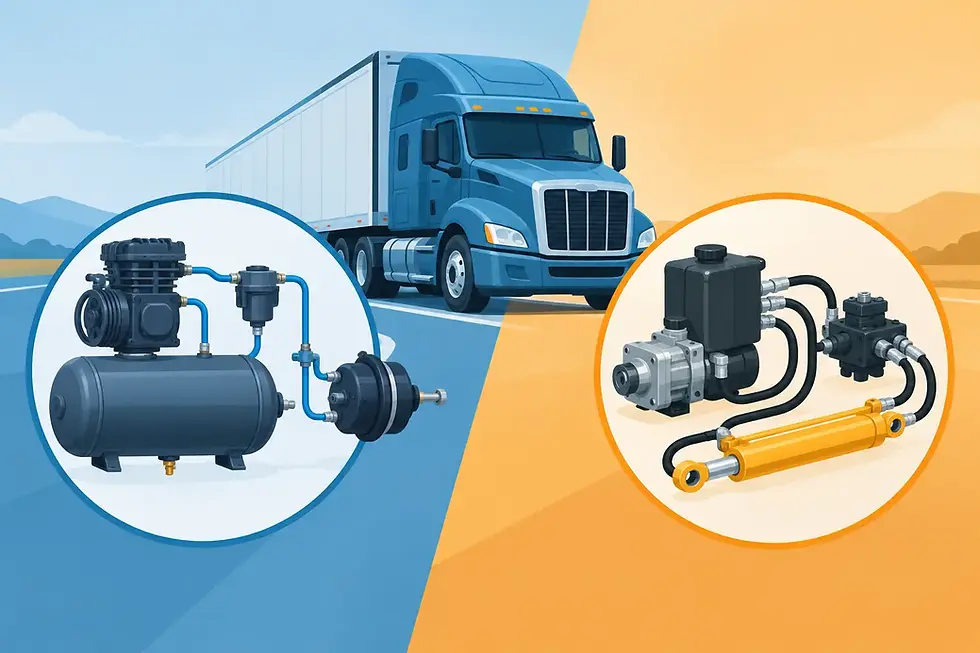
A capable OEM supply partner should also be able to manage customization. This may include alternate mounting brackets, special leg lengths, branded finishes, nonstandard feet, packaging for distributor programs, or coordinated supply with trailer bodies and supporting hydraulic or pneumatic equipment.
Ningbo Han Valley International Trade Co. supports buyers who need that broader sourcing perspective, particularly where landing gear must integrate with custom trailer fabrication and other commercial vehicle systems. The objective is not simply to purchase a component at the lowest initial price. It is to obtain equipment that fits the build, performs in service, and can be supplied consistently as fleet requirements grow.
Build Inspection Into Fleet Maintenance
Even correctly specified landing gear needs regular inspection. Drivers and maintenance teams should look for bent braces, cracked welds, damaged feet, missing fasteners, loose crank hardware, oil leakage around gearboxes, and legs that do not extend or retract evenly. A trailer that leans, binds during cranking, or requires excessive force should be removed from normal use until the cause is identified.
Pay close attention to trailers that are frequently dropped loaded, parked on unpaved surfaces, or exposed to corrosive materials. These units need shorter inspection intervals than trailers operating in controlled freight terminals. Replacing a worn crank or cross shaft early is far less disruptive than dealing with a collapsed or jammed landing gear assembly under a loaded trailer.
The most effective purchase decision starts with the trailer’s actual duty cycle, not a generic capacity label. When front-end load, terrain, mounting geometry, operating frequency, and corrosion exposure are specified clearly, landing gear becomes one less variable in keeping trailers safe, available, and ready for the next dispatch.


Comments